
You turn the dial on your gas range and smell that distinct, sulfurous scent of mercaptan, but the burner refuses to click into life. It’s a frustrating moment that immediately halts your evening plans and brings up valid concerns about household safety. If you’re feeling anxious about potential leaks or the inconvenience of a cold kitchen, you aren’t alone. Most Montreal homeowners prioritize a functional, safe stove but worry about the transparency of service costs. This guide will help you understand the basics of gas stove repair, showing you how to troubleshoot minor issues while identifying the exact moment you need to call a certified professional.
We’ll walk you through the essential safety protocols and the specific Quebec regulations that require all technicians to hold a mandatory gas fitter trade certification. You’ll learn what to look for in a reliable service provider and how to interpret standard Montreal pricing, where diagnostic fees typically range from C$120 to C$149.95. If you understand the difference between a dirty igniter and a faulty valve, then you can manage your kitchen maintenance with confidence. Our goal is to provide the clarity you need to get your appliance back up and running without the fear of surprise billing or hidden fees.
Key Takeaways
- Learn the “Smell, Look, and Listen” framework to identify gas leaks and prioritize your family’s safety immediately.
- Master basic gas stove repair steps, such as cleaning burner caps, to resolve minor ignition issues without a service call.
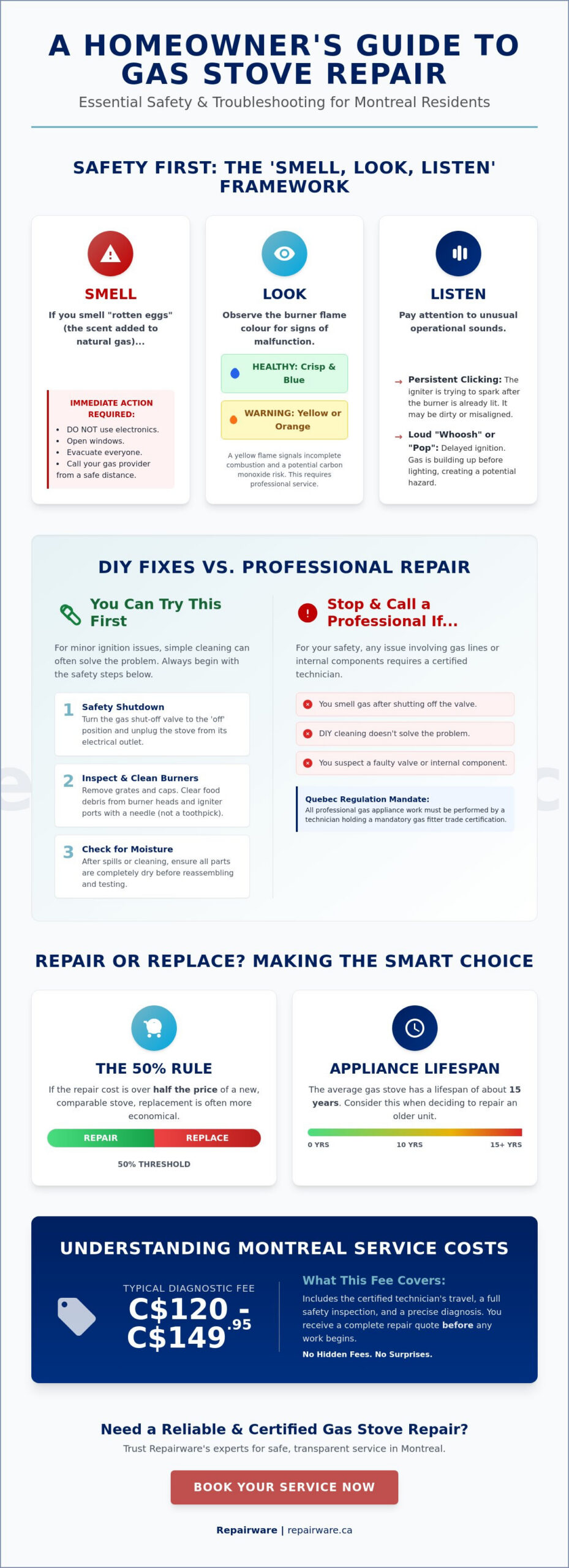
- Apply the 50% Rule to determine if a repair is worth the investment or if your appliance has reached the end of its 15-year lifespan.
- Understand the necessity of hiring Quebec-certified technicians to comply with provincial safety standards and ensure a reliable fix.
- Get clarity on Montreal diagnostic fees and service procedures so you can book your repair with confidence and no hidden surprises.
Gas Stove Repair Safety: What Every Montreal Homeowner Must Know
Safety is the foundation of every successful gas stove repair. Unlike electric ranges that rely on heating elements and circuitry, gas appliances involve pressurized combustible fuel. This fundamental difference means that a minor error can lead to a gas leak or fire hazard rather than just a tripped breaker. In Quebec, safety is so critical that provincial regulations require any individual performing professional gas work to hold a mandatory gas fitter trade certification. If you are unsure about your ability to handle a diagnostic safely, it is always better to contact a certified technician to ensure your home remains protected.
A properly functioning stove should provide clean, efficient combustion. Understanding the History and Technology of Gas Stoves helps you appreciate the various safety mechanisms, such as thermocouples and electronic igniters, designed to prevent accidents. However, these parts can fail over time. You must also maintain proper ventilation in your kitchen to prevent the buildup of carbon monoxide (CO). Since CO is an odourless, colourless gas, ensure your home is equipped with a functional CO detector before you begin any inspection of your appliance.
The ‘Smell, Look, Listen’ Safety Framework
Natural gas is naturally odourless, so suppliers add a chemical called mercaptan to give it a distinct “rotten egg” smell. If you detect this odour, stop what you’re doing immediately. Open the windows, evacuate the house, and call your gas provider from a safe distance. Beyond smell, you should observe the flame colour. A healthy flame is crisp and blue. If you see a flickering orange or yellow flame, it indicates incomplete combustion and a potential carbon monoxide risk.
Listen closely to how your stove operates. A persistent clicking sound after the burner has lit usually suggests a dirty or misaligned igniter. Conversely, a loud “whooshing” sound or a delayed “pop” when lighting suggests a build-up of gas that isn’t igniting promptly. These signs indicate that your range needs professional attention to prevent a more serious malfunction.
Essential Preparation Before Any Diagnostic
If you decide to perform a basic visual inspection, you must prepare the work area correctly. Follow these steps to minimize risk:
- Shut off the gas: Locate the shut-off valve, usually found on the gas line behind the stove or in the cabinet next to it. Turn the handle perpendicular to the pipe to stop the flow.
- Disconnect the power: Most modern gas stoves use electricity for the clock and the igniters. Unplug the unit from the wall outlet to eliminate the risk of electrical shock.
- Clear the area: Ensure your workspace is well-lit and free of flammable items like dish towels, paper, or grease.
If the smell of gas persists even after you have closed the valve, do not attempt any further steps. This is the moment to prioritize safety over DIY savings. You can request a professional diagnostic to have a certified expert identify the source of the leak and get your kitchen back up and running safely.
Troubleshooting Common Gas Range Issues: A Step-by-Step Guide
Many homeowners assume a failed burner requires an expensive gas stove repair, but the solution is often found in basic maintenance. Before you consider replacing parts, follow this four-step diagnostic process to identify if debris or moisture is the culprit. If your range is between 10 and 15 years old, these steps are especially important to distinguish between simple wear and component failure. If these steps do not resolve the issue, you may require an on-site diagnostic by a certified technician to inspect the internal gas lines.
- Step 1: Inspect and clean. Remove the burner grates and lift off the burner caps. If you see charred food or grease buildup on the burner head, it will prevent the gas from reaching the igniter.
- Step 2: Clear the pilot hole. Locate the small notch or hole where the gas exits toward the igniter. Use a thin needle or a specialized cleaning tool to gently clear any blockage. Avoid using toothpicks, as they can snap and cause a permanent obstruction.
- Step 3: Check for moisture. If you recently had a pot boil over or finished a deep clean, the ignition system might be damp. Moisture conducts electricity away from the spark point, preventing a flame.
- Step 4: Test the burner. Reassemble the components once they are completely dry. Ensure the burner cap is seated perfectly flat. A misaligned cap is a common reason for a burner that clicks but never lights.
Deep Cleaning Your Burner Assembly
Safely remove your burner grates and caps by lifting them straight up to avoid scratching the porcelain finish. If the ports in the burner head are clogged, use a stiff, non-wire brush or a needle to clear the openings. For the cleaning solution, a mixture of warm water and mild dish soap is usually sufficient. Avoid using caustic oven cleaners or bleach, as these chemicals can corrode the delicate alloy of the burner heads over time. If the stains are stubborn, a paste of baking soda and water provides a safe, non-abrasive alternative that won’t damage the gas components.
Addressing the ‘Clicking’ Igniter
It is common for igniters to continue clicking even after the flame is visible. This typically happens if the igniter sensor is dirty or if there is lingering moisture in the knobs or the spark switches. You can often dry out a damp igniter by turning the oven on to 350°F (175°C) for 30 minutes; the ambient heat helps evaporate moisture trapped under the cooktop. The spark module acts as the brain of the ignition sequence, sending high-voltage pulses to the electrodes to create the spark needed for combustion. If the clicking persists after the unit is thoroughly dry, the spark module or the individual igniter switch may be faulty and will require professional replacement.
Identifying Faulty Components: Igniters, Valves, and Thermocouples
If deep cleaning the burner assembly does not restore function, the problem likely lies within the internal mechanical components. Gas stove repair becomes more complex when dealing with the electrical and mechanical parts that regulate fuel flow and ignition. Understanding how these parts interact helps you decide when to stop the DIY process and call for professional assistance. You can View our products serviced to see the brands we specialize in before booking your diagnostic.
Internal component failure is often the result of long-term wear or exposure to extreme temperatures. While a homeowner can identify the symptoms of a failed part, the actual replacement involves handling pressurized lines and high-voltage modules. In Quebec, these tasks are strictly regulated. Only technicians with a valid gas fitter trade certification should perform internal repairs to ensure the unit remains safe for daily use.
The Science of the Spark: How Igniters Fail
The igniter is the most common point of failure. Modern stoves use electronic spark igniters that should produce a sharp, blue spark. If you observe a weak, yellow-tinged spark, the component is likely wearing out. High-heat stress from daily cooking and long-term grease buildup eventually degrades the ceramic insulation or the electrode itself. If the igniter glows but fails to spark, the internal coil has likely thinned or cracked, preventing it from reaching the necessary voltage to jump the gap to the burner head. This indicates the component has reached the end of its functional life.
The Thermocouple: Your Stove’s Silent Guardian
Safety is the primary function of the thermocouple. It is a small sensor located near the burner head that generates a tiny electrical current when heated. This current tells the gas valve to stay open. If the thermocouple is faulty, the burner may light for a few seconds but will go out as soon as you release the knob. This is a deliberate safety feature designed to prevent unburned gas from filling your kitchen if the flame is accidentally extinguished. Because this part directly manages gas flow, a malfunctioning thermocouple is a critical safety issue that requires immediate attention.
Beyond the igniter and thermocouple, the gas safety valve and pressure regulator are vital for consistent performance. If you notice a weak flame on all burners simultaneously, or if there is a persistent gas smell coming from the unit even when it is off, the regulator may be failing. These components are factory-calibrated to specific pressures. Any attempt to bypass or incorrectly adjust them can lead to dangerous gas surges or leaks. A professional diagnostic ensures that only the necessary parts are replaced, saving you from the “guess-and-check” method that often leads to higher costs and lingering safety risks.
Repair or Replace? Evaluating the Cost of Gas Stove Maintenance
If you are facing a breakdown, then you must decide whether to invest in a gas stove repair or purchase a new unit. We recommend using the 50% Rule as your primary decision-making framework. If the written estimate for your repair exceeds half the cost of a brand-new comparable range, then replacement is often the more logical financial choice. This calculation helps you avoid “throwing good money after bad” on an appliance that may continue to fail.
The average life expectancy of a modern gas range in Canada is between 10 and 15 years. If your stove is 12 years old and requires a major internal component, you should realize that other parts are likely nearing the end of their functional life. However, if the unit is less than eight years old, a professional repair is usually a sound investment that can extend the life of the machine by several years. Regular maintenance, such as cleaning burner ports and checking seals, prevents the small issues that lead to early system failure.
When to Invest in a Professional Repair
High-end, professional-grade brands like Wolf, Viking, and Thor are almost always worth fixing regardless of age. These units are built with heavy-duty components designed for longevity, and their high initial purchase price makes even complex repairs cost-effective. Minor component failures, such as faulty igniters or broken control knobs, are also inexpensive to resolve on any model. If you are comfortable with basic maintenance, you can read our guide on how to fix a gas range for more DIY tips. When these simple fixes fail, a professional diagnostic ensures you aren’t replacing the entire stove for the sake of a single faulty valve.
When to Consider Replacement
If your appliance has suffered major structural damage or if the manufacturer no longer produces replacement parts, the unit is effectively obsolete. Frequent breakdowns are another clear indicator that the internal systems are failing. You might also consider replacing your stove if you want to upgrade to a model with better energy efficiency and modern safety features. In Montreal, new regulations regarding gas installations in new builds reflect a broader trend toward electrification, which may influence your long-term kitchen planning. If you decide that your current stove still has life in it, you can request a professional diagnostic for C$175 or C$140 to get a clear, honest assessment of its condition.
Professional Gas Stove Services in Montreal: The Repairware Advantage
Repairware operates as a direct, problem-solving partner for Montreal residents facing domestic crises. When your cooking plans are interrupted by a malfunctioning range, you need a dependable hand to resolve the issue immediately. Our team provides professional gas stove repair across the city, focusing on expert technical skill and absolute clarity in communication. We prioritize getting you back up and running with minimal downtime, ensuring your kitchen returns to a safe and functional state.
Our Transparent Service Process
We believe that professional integrity begins with clear expectations. When you book a visit, a fully trained technician arrives to perform a comprehensive on-site diagnostic. After identifying the root cause of the failure, we provide a detailed written estimate that outlines the necessary labour and parts. If the repair requires specialized components from authorized repair centres, then we manage the ordering process and schedule a prompt follow-up visit to ensure 100% satisfaction.
Our pricing model is designed to eliminate the anxiety of “surprise” billing. We require a base service fee of C$175 for the initial diagnostic visit. However, if you Request your service online, then you save 20%, reducing the fee to C$140. This fee is required regardless of the outcome of the visit, ensuring that our experts can provide an honest, unbiased assessment of your appliance’s condition. This transparency allows you to make an informed decision about your equipment without hidden costs or pressure.
Why Montreal Trusts Repairware
Our reputation is built on a no-nonsense approach to appliance maintenance. We understand that a broken stove is a significant inconvenience for any family. Because we value efficiency, our technicians carry common parts to complete many repairs during the first visit. We serve all major Montreal boroughs, providing reliable coverage from the industrial hub of Saint-Laurent to the residential neighbourhoods of the West Island.
If you are looking for a certified professional who values straightforwardness above all else, then our team is ready to help. We stand behind our work with a commitment to guaranteed results, providing the grounded feel of a trusted neighbourhood repairman backed by modern, efficient booking technology. You can find a technician in your area by visiting our locations page to see our full service map. We are committed to providing affordable, prompt, and reliable solutions for every household in the Greater Montreal area.
Restore Your Kitchen Safety and Efficiency Today
Maintaining a functional kitchen requires a balance of regular cleaning and professional vigilance. You now understand how to identify dangerous flame patterns and when a simple cleaning of the burner assembly can save you from a cold dinner. By applying the 50% Rule and recognizing the signs of internal component wear, you can make informed decisions that protect both your family and your household budget. Safety remains the priority; if you detect the scent of gas or see a persistent orange flame, then professional intervention is the only reliable solution.
Repairware has provided dependable service to the Greater Montreal area since 1994. Our expert technicians handle all major brands and provide a transparent, on-site diagnostic for C$175. If you prioritize convenience and savings, then Book your gas stove repair online and save 20% on your service call! to reduce your diagnostic fee to C$140. We are committed to professional integrity and getting you back up and running without the stress of hidden charges. Don’t let a faulty igniter or valve disrupt your routine; secure a reliable fix today and cook with confidence once again.
Foire aux questions
Is it safe to repair a gas stove myself?
You should only perform basic external maintenance, such as cleaning burners or checking igniter alignment, yourself. Quebec law requires any person who installs or repairs gas installations to hold a valid gas fitter trade certification issued by the government. Attempting to open gas lines or replace internal valves without this training poses a significant risk of leaks or fire. If a visual inspection doesn’t fix the issue, you must call a certified professional.
Why does my gas stove keep clicking even after it’s lit?
A persistent clicking sound usually indicates that moisture or debris is interfering with the spark ignition system. If you recently cleaned the cooktop or had a boil-over, liquid might be trapped in the spark switches or the igniter itself. You can often resolve this by letting the unit dry completely or using a hair dryer on a cool setting. If the clicking continues once dry, the spark module or switch likely requires a professional gas stove repair.
How much does it typically cost for a gas stove repair in Montreal?
Most Montreal appliance repair services charge a diagnostic fee between C$120 and C$149.95 to identify the problem. Beyond this, hourly labour rates in the city typically range from C$130 to C$260, plus the cost of any required parts. At Repairware, we maintain transparency by charging a flat C$175 fee for the on-site diagnostic, which is reduced to C$140 if you book through our online system. This fee is required regardless of the outcome.
What should I do if I smell gas near my stove?
If you smell a strong “rotten egg” odour, you must evacuate your home immediately and call your gas provider from a safe distance. Do not operate any electrical switches, use a phone inside the house, or attempt to find the leak yourself. Once the gas provider has secured the site and confirmed it is safe to re-enter, you can schedule a diagnostic to identify the specific mechanical failure in your range.
Can a dirty burner cause my gas stove to not light?
A dirty burner is the most frequent cause of ignition failure. If grease or charred food blocks the pilot hole or the ports where gas reaches the igniter, the spark will not be able to create a flame. You can usually fix this by removing the burner cap and clearing the debris with a non-abrasive tool like a needle. Regular cleaning prevents these blockages from turning into a perceived mechanical breakdown and keeps the system efficient.
How long do gas stoves usually last before they need replacing?
Modern gas ranges in Canada typically have a life expectancy of 10 to 15 years. While the heavy-duty metal components may last longer, the electronic ignition systems and control boards often begin to fail after a decade of regular use. If your stove is older than 12 years and requires a repair costing more than 50% of its original value, it is generally more cost-effective to replace the unit with a newer model.
Does Repairware offer a warranty on gas stove repairs?
We stand behind our work with a commitment to 100% satisfaction and guaranteed results. Our technicians provide a written estimate before any work begins, ensuring you understand the scope of the repair. If we replace a part, it is sourced from authorized repair centres to ensure compatibility and longevity. This professional approach provides the dependability Montreal homeowners need when dealing with the complexities of gas-powered kitchen equipment.
How can I book a repair and save on the service fee?
You can book your service through our online AI Assistant to receive an immediate 20% discount on your diagnostic fee. This reduces the standard C$175 on-site visit cost to C$140. Simply visit our request service page, select your appliance type, and choose a time that fits your schedule. This discount is our way of rewarding prompt booking and helps us get your kitchen back up and running as efficiently as possible.
 English
  Français du Canada