
Replacing your treadmill motor might seem like the obvious fix when the belt stops moving, but it’s often a wasted investment if you haven’t addressed the underlying friction issues first. You’ve likely spent a significant amount of money building your home gym, so it’s natural to feel anxious when your equipment fails. Nobody wants to face a surprise repair bill only to realize they could have bought a brand new machine at a local retailer for a similar price.
We understand the frustration of trying to determine the repair or replace treadmill motor cost while dealing with confusing technical jargon and high part prices in Canada. This 2026 guide provides the transparency you need to make an informed financial decision for your household. We’ll explain how to distinguish between motor failure and controller board issues, outline a logical rule for when to scrap an aging machine, and show you why professional maintenance is the key to protecting your investment. By the end of this article, you’ll know exactly whether to book a repair service or start shopping for a new model.
Key Takeaways
- Identify the three critical “red flag” symptoms to determine if your motor is actually failing or if the issue lies with the control board.
- Compare the current market prices for DC and AC motors to accurately calculate your total repair or replace treadmill motor cost.
- Apply the “50% Rule” and the 10-year age limit to decide whether to invest in a repair or transition to a new machine.
- Discover how professional calibration prevents new components from burning out and ensures the long-term safety of your home gym equipment.
- Gain clarity on labour rates and diagnostic fees to ensure you receive honest, transparent service without hidden costs.
Diagnosing Treadmill Motor Issues: Is it Actually the Motor?
A treadmill motor is the drive system that converts electrical energy into mechanical torque. Before you commit to the repair or replace treadmill motor cost, you must determine if the motor is actually the culprit. Many homeowners assume a dead machine means a dead motor, but the issue often lies in the electronics or the belt. For a comprehensive overview of the treadmill and its internal mechanics, understanding how these components interact is vital for an accurate diagnosis.
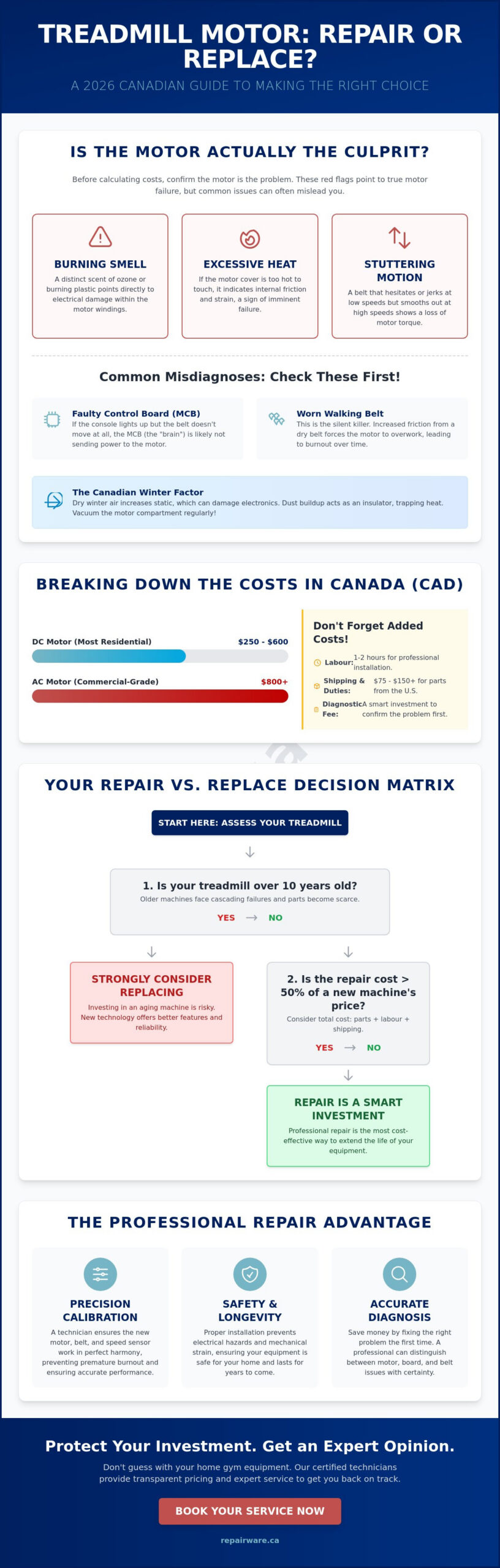
There are three specific red flags that indicate a motor is failing: a distinct smell of ozone, excessive heat radiating from the motor cover, or a stuttering motion during use. If your machine’s console powers on but the belt fails to move, the problem might be the motor control board (MCB) rather than the motor itself. The MCB acts as the brain; if it can’t send power, the motor remains dormant. Additionally, a worn walking belt is the most common silent killer. As the belt loses its lubrication, friction increases, which forces the motor to draw more current and eventually “cooks” the internal windings. If you find yourself in this situation, professional treadmill repairs can help identify the exact point of failure.
The “Smell Test” and Other DIY Checks
If you suspect a failure, safely perform a smell test by leaning toward the motor housing while the machine is running. A scent of burning plastic or ozone usually confirms electrical damage. You should also test the treadmill at low speeds compared to high speeds. If the belt stutters at low speeds but moves smoothly at high speeds, it indicates a loss of torque. This loss of power is a classic sign that you need to evaluate the repair or replace treadmill motor cost for your specific model.
Static and Dust: The Canadian Winter Factor
In Montreal, the dry indoor air during winter creates a significant challenge for fitness equipment. Low humidity levels increase static discharge, which can jump from the walking belt to the motor and fry sensitive components. Dust also acts as a dangerous insulator, trapping heat inside the motor housing. We recommend vacuuming the motor compartment every few months to prevent this buildup. Keeping the area clean ensures the motor remains cool during peak use, extending its lifespan significantly.
The Real Cost of Repairing vs. Replacing a Treadmill Motor in Canada
Understanding the actual repair or replace treadmill motor cost requires looking beyond the price tag of the part itself. In Canada, homeowners face unique logistical challenges that can inflate the total bill. Most residential units use DC motors, which typically range from $250 to $600 CAD. If you own a high-end commercial-grade machine with an AC motor, expect costs to start at $800 and climb significantly higher based on the horsepower rating.
A significant portion of treadmill components are manufactured or stocked in the United States. Shipping a heavy motor across the border often incurs high freight charges and customs duties. These hidden fees can add $75 to $150 to your total expense before a technician even arrives. Paying a fixed diagnostic fee is a smart move to protect your budget. It prevents you from ordering an expensive motor when the problem might actually be a simple sensor or a frayed wire. This transparency is supported by evolving Right to Repair legislation, which encourages manufacturers to make parts and manuals more accessible to consumers and independent shops alike.
Parts Pricing: Brand Name vs. Universal Motors
Premium brands like NordicTrack or Life Fitness often use proprietary mounting brackets or specific shaft lengths. While universal motors exist, they rarely offer a perfect fit for high-performance machines. Using a non-OEM (Original Equipment Manufacturer) motor can lead to alignment issues or premature failure of the drive belt. Investing in the correct part ensures the machine operates at its intended torque and speed.
Labour and Service Call Expectations
A professional treadmill repair usually takes between one and two hours. This time includes more than just swapping the hardware; a technician must calibrate the speed sensor and ensure the belt tension is perfectly balanced to avoid straining the new motor. If you need a professional assessment to avoid costly mistakes, you can book an inspection online to get your equipment back in working order.
The “Repair vs. Replace” Decision Matrix: When to Invest
Deciding whether to salvage your current machine or invest in a new one requires a logical assessment of value. We recommend using the “50% Rule” as your primary guide. If the total repair or replace treadmill motor cost reaches more than 50% of the price of a comparable new model, the investment is usually not justified. For instance, if a replacement motor and labour costs half as much as a brand new machine, purchasing a new unit with a fresh warranty is the more logical choice. This rule helps homeowners avoid spending significant sums on entry-level models that weren’t designed for long-term component replacement.
The age of your equipment is the second critical factor. Most treadmills manufactured over 10 years ago rely on electronic components that are now obsolete. Even if you find a replacement motor, the motor control board or console might fail shortly after; this leaves you with a repaired motor but a non-functional machine. You must also inspect the deck and belt. If the walking belt is thin and the deck shows significant wear patterns, replacing the motor alone won’t solve the underlying friction issues discussed in previous sections.
When to Choose Repair
If your treadmill is under five years old and the frame remains in excellent condition, a repair is usually the smartest path. This is especially true for machines with high-performance motors (3.0 CHP or higher). These units are built to last, and professional fitness equipment repair can effectively double the lifespan of premium brands. If you aren’t sure about the state of your electronics, you can book a professional diagnostic visit to get a clear quote.
When to Choose Replacement
You should consider replacement if the frame shows signs of structural rust or the running deck is cracked. These issues compromise safety and cannot be easily fixed. Additionally, if parts for your specific brand are no longer stocked in Canada, the wait times and import fees often make replacement the more practical choice for your home gym.
Professional Repair Solutions: Ensuring Longevity and Safety
Professional calibration is the final step in securing your fitness investment. A new motor is only as effective as the system supporting it. If the controller board isn’t calibrated to the new motor’s specific amperage draw, you risk a secondary failure within weeks of the repair. Our approach to appliance repair in Montreal prioritizes this level of technical precision and total billing transparency. Professional service includes a labour warranty, providing a safety net that DIY attempts simply cannot offer. When calculating the total repair or replace treadmill motor cost, the peace of mind from a guaranteed fix often outweighs the perceived savings of a solo project.
Why DIY Motor Replacement Often Fails
Replacing a motor involves more than just turning a few bolts. Aligning the drive belt requires extreme precision to prevent uneven wear on the motor bearings and walking belt. Another significant hurdle is the speed sensor, or reed switch, which must be perfectly positioned to communicate with the console. Safety is also a major concern. The motor controller board contains high-voltage capacitors that can deliver a dangerous shock even when the treadmill is unplugged. Professional technicians have the training and specialized tools to discharge these components safely.
Post-Repair Maintenance to Protect Your Investment
Once your repair is complete, consistent maintenance is your best defence against future failures. You must lubricate the deck every three months or every 150 km of use. This simple task reduces the friction that likely caused your original motor to overheat. You should also check the belt tension regularly. A belt that is too tight puts unnecessary strain on the motor’s internal windings, while a loose belt causes slipping and erratic speed changes. Following these steps ensures your machine operates efficiently for years to come.
If you are ready to restore your home gym to its full utility and want a clear, honest assessment of your equipment, you can submit a service request for a professional diagnostic today.
Restore Your Home Gym Performance
Deciding on the repair or replace treadmill motor cost doesn’t have to be a stressful experience. By applying the 50% rule and checking for underlying belt friction, you can avoid throwing good money after a machine that has reached its mechanical limit. If your treadmill is a premium model under ten years old, a professional repair is often the most sustainable and cost-effective choice for your household budget. This approach ensures you aren’t paying for a new machine when a targeted component fix would restore full utility.
Our expert technicians have served the Greater Montreal area since 1994, providing a steady hand for complex fitness equipment issues. We specialize in premium brands like NordicTrack, Sole, and Life Fitness, ensuring your high-performance machine receives the exact calibration it requires. We maintain a strict policy of transparent pricing with no hidden fees; this ensures you always know the exact state of your equipment before work begins. Don’t let a malfunctioning motor disrupt your fitness routine or create unnecessary safety risks in your home.
Book a Professional Treadmill Diagnostic in Montreal today to get a definitive answer on your machine’s condition. We look forward to helping you return to your normal training schedule with confidence.
Foire aux questions
How much does a treadmill motor cost to replace in Canada?
Replacing a treadmill motor involves both the price of the part and the professional labour for installation. In Canada, the specific model of your machine determines the price; high-performance AC motors found in commercial units cost significantly more than standard residential DC versions. You must also consider the expense of shipping heavy components, which often originate from international warehouses. A professional diagnostic ensures you understand the total repair or replace treadmill motor cost before any work begins.
Can a treadmill motor be repaired instead of replaced?
You can sometimes repair a motor if the issue is limited to replaceable components like worn carbon brushes or a faulty cooling fan. If the internal copper windings have melted due to friction-induced heat, the motor is typically considered non-repairable and requires a full replacement. A technician can test the internal resistance to see if a repair is technically feasible. In most cases, installing a new factory-sealed motor provides better long-term reliability than attempting to rebuild a burnt-out unit.
How long should a treadmill motor typically last?
A high-quality treadmill motor should last between seven and twelve years if it receives proper care. The lifespan depends heavily on the cleanliness of the motor housing and the condition of the walking belt. If you allow dust to build up or run on a dry, unlubricated deck, the motor will work harder and fail much sooner. Regular maintenance is the most effective way to ensure your motor reaches its maximum potential age without requiring premature replacement.
Is it dangerous to use a treadmill if the motor is making a loud noise?
It is not safe to use a treadmill that is making loud grinding, screeching, or buzzing noises. These sounds often indicate that the motor bearings have failed or that there is an electrical short in the windings. Using the machine in this condition can cause the motor to seize suddenly, which presents a serious fall risk for the runner. You should stop using the equipment immediately and disconnect it from the power source until a professional can inspect the drive system.
Will a new motor make my treadmill run like new again?
A new motor will restore the machine’s power and torque, but it won’t compensate for a worn deck or a damaged belt. If these other components are in good shape, the treadmill will feel significantly smoother and quieter after the motor replacement. You must ensure the technician calibrates the speed sensor and aligns the drive belt during the installation process. Without these critical adjustments, the new motor will experience excessive strain and may fail shortly after the repair.
 English
  Français du Canada